



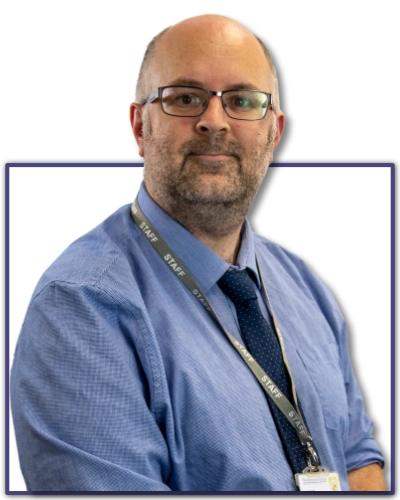
Mr GarlandHead of IT
The Computing and ICT faculty is made up of Computing at Key Stage 3, followed by both ICT and Computer Science at Key Stage 4.
The head of department is Iain Garland, who joined The Wilnecote School as an NQT in 2006 following the completion of a Computer Science degree and four years as a professional programmer. As such the gradual drift towards Computer Science in recent years has meant Wilnecote’s Computing and IT department is one of the few schools with a genuine Computing specialist leading the faculty.
The rest of the department is made up of three other experienced members of teaching staff. Stephen Simpson joined the school a couple of years after Iain, also as an NQT having previously been a student at the school, and currently also holds an assistant head position in charge of safeguarding and relationships having spent several years as the 2nd in department for Computing and IT. Lisa Drewett joined the in 2023 having spent over 20 years in a range of roles including Head of Business and IT at schools in Walsall and Burntwood, and is leading the school’s new initiative of bringing Business and Enterprise back as a Key Stage 4 option, in addition to teaching Computing and IT to Years 7-11. Our latest member of the department is Jessica Taroni, joining in 2025 and bringing valuable experience from a range of teaching and pastoral roles and running her own successful businesses, to develop and teach both Business Studies at KS4 and Computing and IT in KS3.
Vision for ICT at The Wilnecote School
In terms of the learning itself, the world of computing is a fast-moving and exciting part of our world and beyond, and our curriculum from Years 7 to 11 reflects the importance and diversity of the applications of computing and IT. In the Key Stage 3 Computing curriculum there are 6 units of work per year, covering a range of topics from the world of Computer Science, IT, Media and Business. By completing such a wide range of topics with clear and strong links to the National Curriculum, students receive a deep, broad curriculum offering multiple ways to help inform future decisions. The use of key software to create various products in commonly used applications will allow students to utilise these skills in the future, and be able to develop solutions to a huge range of potential projects and requirements. The units covered have been written by members of the department to allow individual specialisms to benefit the lessons, and as such topics are interesting and engaging with a range of enjoyable tasks throughout. Units build on previously taught skills and knowledge, allowing students to use prior learning to develop deeper and more detailed understanding of more complex topics covered later in the years.
In Key Stage 4 students have the choice of Computer Science, IT and Business & Enterprise, with each qualification following its own path and being distinctly different to the other to allow students the chance to follow the course that interests them the most, or indeed pursue both avenues for a wider range of learning. Computer Science looks at the technical side of Computing, letting students find out about how
computers work, how they store and process data and how to program them using text based languages.
In Year 10 and 11, ICT is its own subject away from Computing, and allows students to focus on the more real world use of computer systems as well as project development and software life cycles.
Business Studies is the latest new subject in our department, and allows students to learn about how businesses run, the processes involved in setting up a business, as well as a range of learning around the intricacies of businesses and enterprise.
Road Maps
Please note that this assessment calendar and the listed assessment dates are indicative and may be subject to change in order to accommodate operational requirements.